
When Words Fail
Creativity is another path

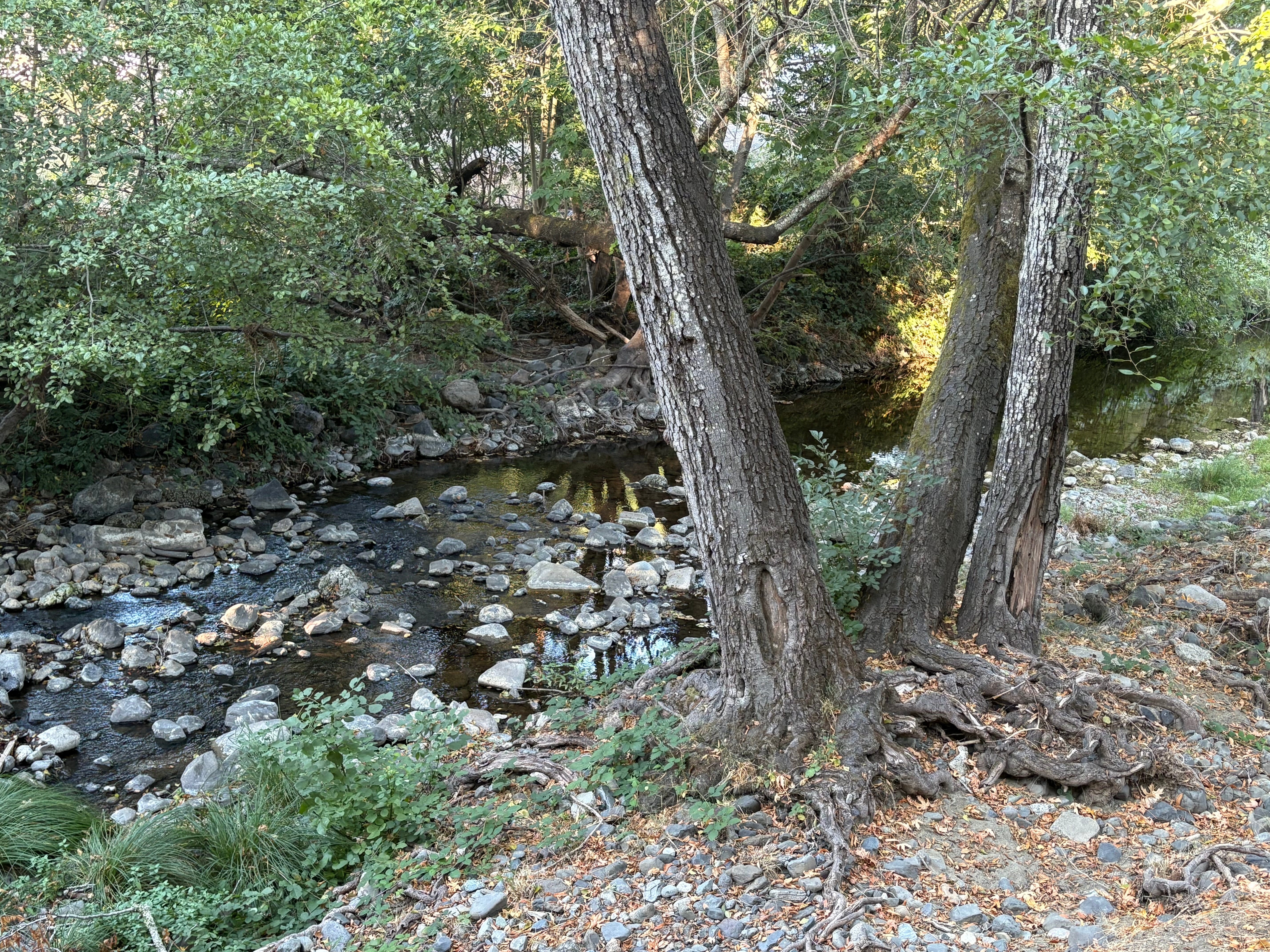
I’m spending a few nights with a dear friend at her sweet little home on a creek in Sonoma County. It’s a welcome respite from the relentless doing that has consumed my life since returning from Cape Cod–task lists, business administration, chores–all sorts of activity that crowds out reflection.
This morning, I sat down to write and stared at the page again. Lately, I haven’t wanted to write. The motivation that carried me through so many months of treatment—hyper-focused, purposeful, intensely alive—has evaporated. All the urgency is gone. And in this space I worked so hard to earn, I find stillness. And stuckness.
My brain was sluggish, as if bogged down in a pile of thick, cold goo. I persisted, writing a few pages, growing bored, stopping. What the hell? Where’s the flow? And what’s the wet muck in my skull casing that replaced it?
I suspect I’m not alone. Most of us spend our days consumed by a "doing, doing, doing" mentality. We don’t stroll, we hike or power walk. We don’t reflect, we strategize. All this doing systematically blocks access to our creativity.
I gave up on writing and took Bonnie for a long walk. Passing through a large stand of oaks, I let my mind wander.
We arrived at a dog park. The huge, grassy enclosure was filled with 10 or so dogs, and after a few exploratory butt sniffs, Bonnie joined the mix. As we watched our dogs chase balls and each other, and jump into the kiddie pool on the edge of the enclosure, the humans began to interact. Pretty soon, everyone was sharing stories and laughing.
Walking back, I felt something shake loose. Thoughts began to flow–stories, memories, ideas, and interests. My mind was active, but relaxed, like back floating in the ocean, working and resting at the same time. I felt an urge to create.
In Beyond Anxiety, Martha Beck writes about how our analytical brain - the part that keeps me frozen in front of my computer screen, trying to think my way into creativity - is the same neural structure that amplifies anxiety. She describes an 'anxiety spiral' that can increase anxiety indefinitely, and explains that to break free, we must engage different parts of our nervous system - the parts involved in creativity.
Watching Bonnie and her new friends play, I was witnessing pure creativity in action. They were simply being in the moment, responding to each other with curiosity and wonder, engaging in joyful, directionless movement.
That's what my brain needed. Not more thinking, but less. Not analysis, but play. Not trying to force words onto the page, but letting my mind drift aimlessly - which, as it turns out, isn't aimless at all.
This wasn't my first encounter with the creative path. Shortly after my cancer diagnosis, I joined Art for Recovery, a program for cancer patients at UCSF. AFR offers a safe environment to express the intense feelings that arise during life-threatening illnesses. I was wildly uncomfortable the first time I joined the group. I’ve never thought of myself as an artist, and the idea of making visual art intimidated me. I was sure I’d embarrass myself.
But it was safe, a place for conversation, silence, and surrender. Call and response. The call was a poem or an excerpt of creative writing. The response: make art. Patrice, the harpist, played soft, exquisite notes that made the creative silence feel warm and snuggly.
Looking at my early pieces, I don’t see progress in my technique, but I see something else: access. A loosening. A kind of alchemy. Emotions I couldn’t name showed up on the page in shapes and colors. Like they had somewhere to go. I love to write, but when I'm in the throes of strong emotions, words get loopy and confine me in the echo chamber of what hurts, like being trapped in a dark, cold, dank basement with no way through.
Artistic expression gave me a way through. It unlocked the feelings and helped me express them without words, which was therapeutic. It also gave me access to positive emotions. Creation demands a vision. It could be a bleak and dark vision, but for me, the vision was often beautiful and comforting.
I shouldn't have been surprised by art's healing power. Years earlier, when my daughter was small and struggled with emotional self-regulation, I'd set up a little square art table and chair by the window in our family room - nothing fancy, just crayons, markers, paints, and paper. When things got hard for her, she'd go there to process feelings she couldn't yet name. Watching her small hands work through big emotions without needing words taught me something I'd later rediscover for myself.
What makes the creative process so magical is that you don't have to find the right word. You can let your hand speak for you. There's something extraordinarily powerful about that.
That wordless power called me again in July. I received an invitation from Art for Recovery to submit a piece for a first of its kind collaboration with the San Francisco Museum of Modern Art to showcase patient art. I felt a tug on my heart and a knot in my belly. I called my daughter, a painter whose work consistently fills me with delight and awe.
“Hey, I have a collaboration idea for the AFR/MOMA exhibit.
“Mom…”
“I’ll write a poem and you paint the canvas. We’ll mount the poem on the canvas. How cool would that be?”
Silence filled the air. Slowly, gently she said, “Mom, it doesn't work that way. If you're going to submit it, it has to be yours.”
“But, I’m not an artist. You’re the artist.”
“You don’t have to do this. But if you really want to, I'll support you. I'll give you the paints, I'll even rub your shoulders while you paint, but you have to make your own art.”
Well, shit. OK, forget it. I’ll let this one go.
But the tug to create was strong. I was just starting to feel alive again, and wanted to do something that filled me with electricity, that made me feel a pulse of life. I hung up the phone and got to work.
I wrote a poem about the complex feelings of remission. That was the easy part. Now, I faced the art challenge–how to mount this poem artistically. I researched. I bought and borrowed a bunch of supplies. I talked to “real artists.” I threw away many efforts. Eventually, I landed on an idea that resonated with me, pebbles and river rocks, bathed in gold paint.
While I was creating, I was not thinking or planning or doing chores. I gave myself fully to the process.
My piece was selected and will hang on a wall next to real artists’ pieces. The thought of people seeing it is terrifying. I have huge imposter syndrome. But it's mine. I was brave. And I found joy and satisfaction in the creative process.
I'm still feeling pulled to create. Life feels so heavy and hard right now. We all could benefit from a creative outlet, whether that be journaling, or doodling, or painting, or playing with Play-Doh.
Watching Bonnie and the other dogs–joyful, directionless, free–reminded me that creativity doesn’t start from mastery. It starts from motion. From letting the light in to soften the goo.
So here I am again. Moving. Writing. Creating. Nothing is polished to perfection, but that’s not the point. Creativity for the sake of creativity is the point.
And that’s enough.
Also cheers to your daughter for not letting you hide behind her. She is wise, just like you!
I'm doing mixed-media encaustic. Very fun. I'm advocating that we let 'art' be a verb. We're "arting" :-) Glad you found your way through the grind to the art.